

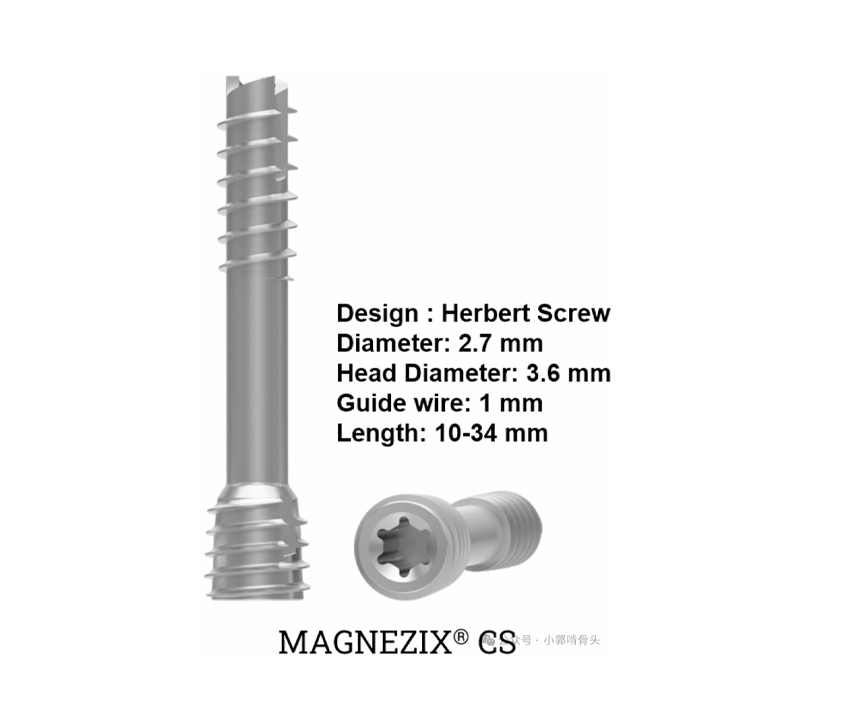
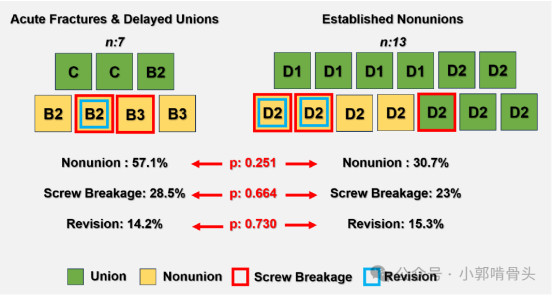
Previous studies have believed that magnesium (Mg) screws have the advantages of bone induction and progressive degradation, but in this study, through an average follow-up of 78.3 months (6.5 years) in 20 patients, it was found that 40% bone disconnection rate, 25% screw fracture rate and common cystic lesions were found. The degradation of Mg screws produces hydrogen gas, which leads to early cystic degeneration and weakens the fixation stability; the blood supply to the carpal bone is poor and the bone volume is small. The rapid degradation of Mg screws cannot meet the long-term mechanical support required for bone disconnection.

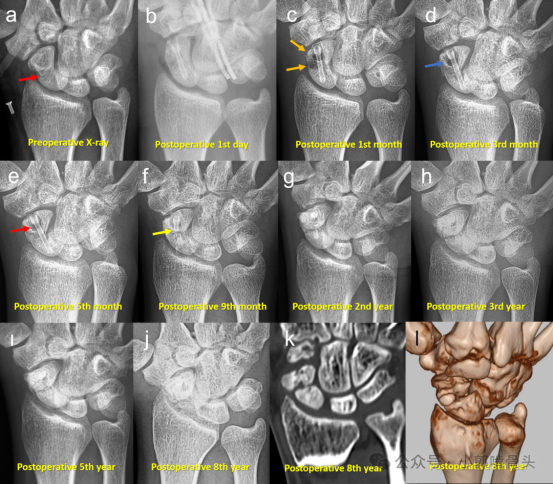
A 22-year-old male patient suffered a fracture of the boat bone (Herbert B2 type, that is, a complete fracture of the boat bone lumbar) due to a motorcycle accident. He received internal fixation treatment with magnesium screws and a series of imaging follow-ups. The patient is a non-smoker, and the postoperative imaging performance is as follows: (a) preoperative X-rays show acute boat bone fractures (marked by red arrows). (b) The X-ray on the first day after the operation shows the position of the internal fixation of the magnesium screw. (c) Follow-up X-rays for 1 month after surgery showed the formation of intraosseous gas (marked by orange arrows). (d) Follow-up X-rays for 3 months after the operation showed a decrease in gas formation (marked by a blue arrow). (e) Follow-up X-rays for 5 months after the operation showed that there is still gas in the bone, especially around the head of the screw (marked by a red arrow) (f) Follow-up X-rays for 9 months after the operation showed signs of screw fracture and bone disconnection (marked by a yellow arrow). (g) Follow-up X-rays for 2 years, (h) 3 years, and (i) 5 years after the operation showed clear bone disconnection and the contour of the screw gradually blurred. (j) The final follow-up X-rays for 8 years after the operation showed progressive non-healing collapse (SNAC) of the boat bone and fragmentation of the boat bone. (k) CT scans and (l) 3D CT reconstruction also confirmed the above imaging performance in the 8-year follow-up after surgery.
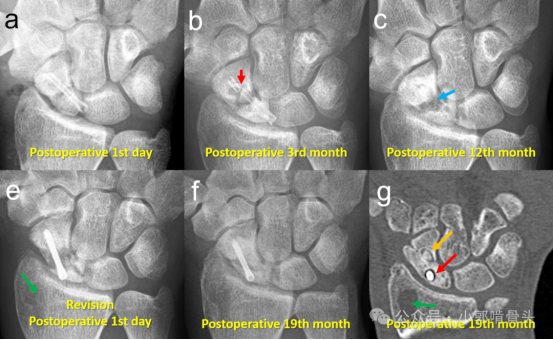
A 20-year-old male patient suffered a boat bone fracture (Herbert D2 type, that is, the formation of a false joint) due to a sports injury. He received magnesium screw internal fixation treatment and underwent a series of imaging follow-ups. The patient initially received conservative treatment for 3 months, and then turned to surgical treatment. The postoperative imaging performance is as follows: (a) The initial postoperative X-ray shows the position of the magnesium screw and the gas formation at the tip of the radial stalk process. (b) The third month after the operation: The formation of cystic gas in the boat bone increases, and screw fracture occurs (marked by a red arrow). (c) The 12th month after surgery: The magnesium screws at the fracture plane almost completely disappeared, and false joints appeared (marked by blue arrows). (e) The first day after the refurbishment operation: images after receiving autologous bone grafting refurbishment surgery. (f) The 19th month after surgery: The fixation device is stable and the bone at the fracture site heals well. (g) CT scan in the 19th month after surgery: detailed display of the location of the fixation device and osseointegration. The orange arrow is marked as the previous magnesium screw, the red arrow is marked as the titanium screw, and the green arrow is marked as the bone grafting supply area.
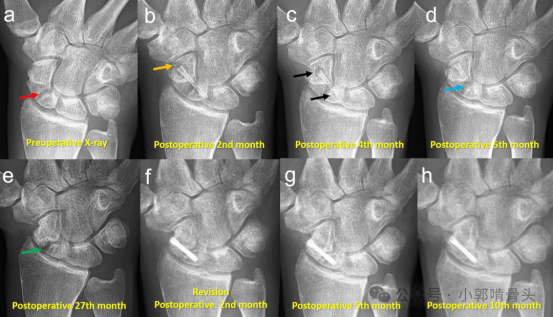
A patient was initially fixed with magnesium screws due to a fracture of the boat bone, but later replaced with titanium screws due to incomplete bone repair. The imaging progress is as follows: (a) Preoperative X-rays: Showing a boat bone fracture (marked by a red arrow). (b) The second month after surgery: early X-rays after the initial fixation, the orange arrow shows the formation of gas around the screw head. (c) The 4th month after surgery: continuous observation shows that the fracture site is not healed and the screws are loose (marked by black arrows). (d) The 5th month after surgery: the fracture line persists with no signs of healing (marked by blue arrows). (e) The 27th month after the operation: The bone fracture of the boat bone is still in a state of disjointed bone (marked by a green arrow), and the screw is absorbed at the same time. (f) The second month after the renovation: X-rays after the titanium screws are fixed. (g) The 5th month after renovation: signs of delayed healing are shown. (h) The 10th month after the refurbishment: follow-up showed that the fracture gradually healed and the position of the titanium screw was stable.
Excerpted from-Xiangya Third Hospital Guo Yisen Xiao Guo Gnawing Bones June 6, 2025 17:52 Hunan
 Home
Home Products
 Telephone
 Message